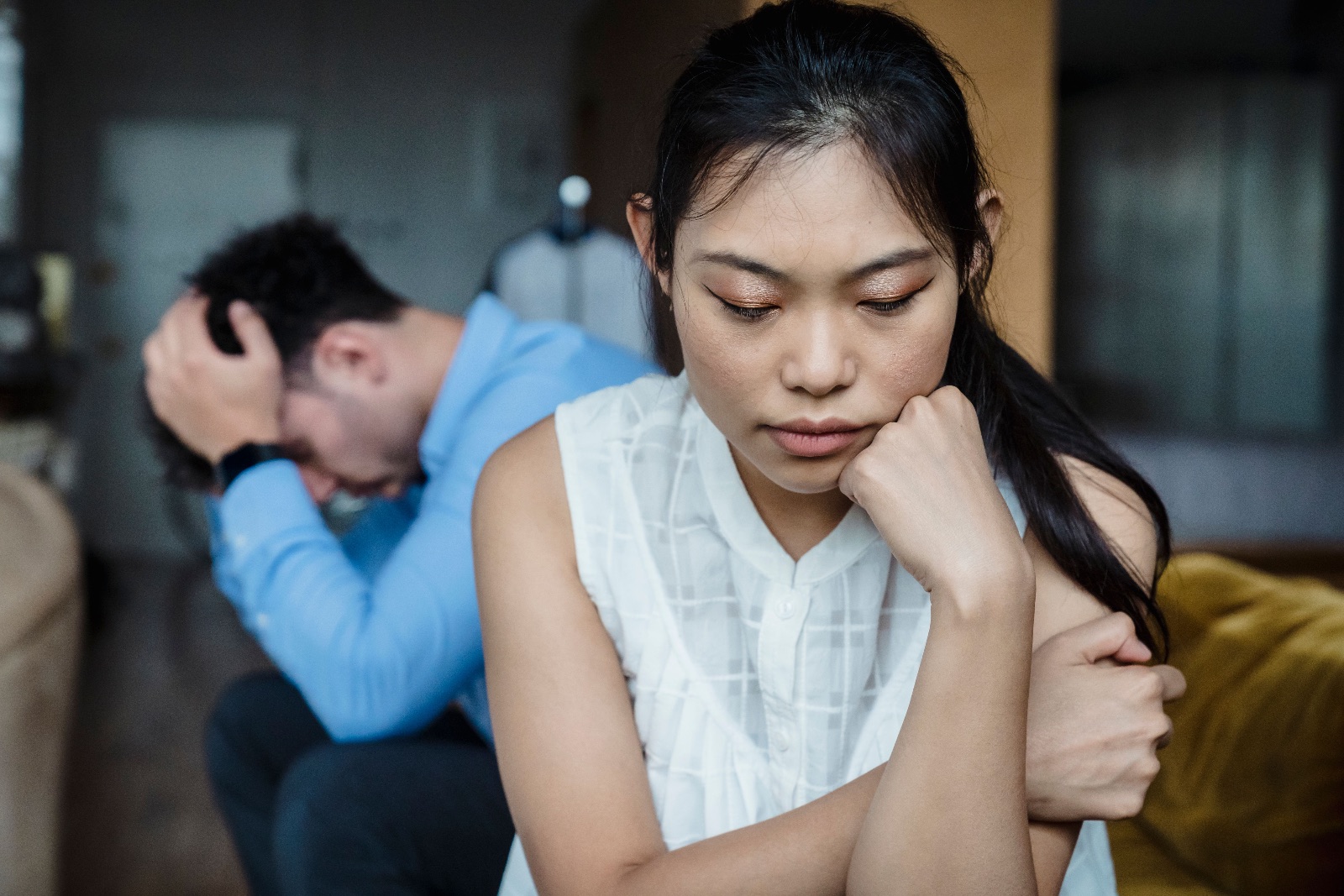
If you are wondering how to know if your marriage is over, look less at whether you are fighting and more at what remains between you. Persistent emotional disconnection, contempt, avoidance, repeated injuries without repair, and the loss of willingness to work on the relationship can matter more than how often you argue.
The harder truth is that there is rarely one moment when a marriage becomes officially "over."
You may still love him. You may have children together, years of memories, a mortgage, traditions, friendships, and an entire life built around being "us." And at the same time, you may lie next to him at night feeling profoundly alone.
That contradiction is what makes this question so painful.
How to know if your marriage is over
Start with five questions:
- Do we still have emotional connection, even occasionally?
- Can we repair things after we hurt each other?
- Can I be honest about what I feel without constantly protecting myself from the response?
- Is there still respect between us?
- Are both of us willing to do something different?
A "no" to one of these questions does not mean you should divorce. But if your answer has been "no" to most of them for a long time, that deserves your attention.
The distinction is between a marriage that hurts and a marriage in which meaningful participation has stopped.
Pain can exist in relationships that still have enormous capacity for connection. What becomes more concerning is when neither repair nor engagement seems to happen anymore.
Is constant fighting a sign your marriage is over?
Not necessarily.
Fighting can feel terrible, especially when you keep circling the same argument. But conflict often means that at least one of you is still trying to be heard, understood, reassured, respected, or valued.
Attachment theory helps explain why some arguments become so repetitive. Underneath "You never help me" may be "Do I matter to you?" Underneath "Why are you always criticizing me?" may be "Am I safe being myself with you?"
If you recognize that pattern, you may want to read Why You Keep Having the Same Fight, Just in a New Outfit.
Sometimes what worries you more isn't fighting. It is when you stop caring enough to fight.
You stop asking where he has been. You stop explaining why something hurt. You stop reaching for him because you already expect nothing to happen.
That kind of resignation deserves attention.
What does emotional disconnection actually look like?
Emotional disconnection is often quieter than people expect.
You may function perfectly well together. You coordinate school schedules, pay bills, attend family events, make dinner, take vacations, and discuss what needs fixing around the house.
But almost everything between you has become logistical.
You no longer tell him the thing you were thinking about in the car. You do not instinctively reach for him when something scares you. You stop sharing the vulnerable parts because somewhere along the way it became easier to keep them to yourself.
You can become excellent roommates while feeling almost invisible as partners.
That does not automatically mean the marriage is finished. It does mean the emotional relationship needs to be examined rather than assuming that functioning well as a household means you are functioning well as a couple.
What if I feel nothing toward my husband anymore?
Feeling numb can be frightening because it seems so final.
But "I don't feel anything anymore" can mean several different things. Sometimes affection has genuinely diminished. Sometimes you have spent so long feeling disappointed, angry, rejected, or overwhelmed that emotional distance has become protective.
Your nervous system can learn that reaching toward someone repeatedly leads to pain. Eventually, not reaching can feel safer.
That is why you do not necessarily need to make a permanent decision based solely on what you feel during your most exhausted season.
Instead, get curious about the numbness.
When did it begin? What happened before it? What have you stopped saying? When you imagine genuine change in the relationship—not simply promises—does any part of you want to move toward him again?
Those answers may tell you more than the numbness itself.
What are the strongest warning signs in a struggling marriage?
There are several patterns worth taking seriously when they become persistent:
1. Contempt has replaced respect
The Gottman Method identifies contempt as a particularly destructive relationship pattern. It can look like mockery, disgust, eye-rolling, humiliation, belittling, or treating your partner as fundamentally beneath you.
This is different from anger. You can be furious with someone you still respect.
2. Nothing gets repaired
Healthy couples hurt each other too. The difference is not perfection; it is repair.
An apology happens. Someone takes responsibility. Behavior changes. You reconnect.
When injuries simply accumulate, resentment can begin replacing intimacy.
3. You have stopped being emotionally honest
Maybe telling the truth creates another fight, so you say, "It's fine."
Eventually you may become so practiced at keeping the peace that your spouse no longer knows what is happening inside you.
Peace purchased through silence is not necessarily connection.
4. One person has stopped participating
One person cannot create a mutual relationship alone.
You can work on your reactions, boundaries, communication, and emotional awareness. But you cannot force another adult to become curious, accountable, affectionate, faithful, or willing to work on the relationship.
5. You repeatedly imagine life without the marriage
Thinking about divorce during a terrible argument is different from repeatedly imagining a separate life and experiencing that thought primarily as relief.
Do not treat that feeling as an automatic instruction to leave. Treat it as information worth exploring.
How do I know whether I am done or simply exhausted?
Ask yourself a more precise question:
Do I want this marriage to end, or do I desperately need the marriage as it currently exists to end?
Those are not the same thing.
You may not want another twenty years of loneliness, criticism, rejection, betrayal, unequal responsibility, or emotional distance. That tells you something important about what cannot continue. It does not necessarily tell you whether the relationship itself must end.
Try imagining two realistic futures.
In the first, nothing meaningful changes for three years.
In the second, both of you consistently address the problems—not perfectly, but sincerely.
Notice your response to each.
The point is not to predict your future. It is to separate hopelessness about the current pattern from certainty about the relationship.
What if only one of us wants to save the marriage?
This may be one of the hardest situations because effort itself can become painful.
You read the books. You initiate conversations. You suggest counseling. You change how you approach conflict. You wait.
At some point, the question becomes whether your spouse is participating too.
Willingness does not require him to know exactly what to do. It might sound like, "I don't know how to fix this, but I don't want to keep living this way either."
That is different from refusing every conversation, dismissing your concerns, or expecting you to carry the entire emotional burden indefinitely.
Couples therapy in Naples can provide a structured place to determine what each person is actually willing to work on rather than having the same conversation at home repeatedly.
Should I stay for the children?
Children make this decision more complicated, not less.
You may fear breaking their family apart. You may also worry about what they are learning from watching your marriage.
There is no universal answer based simply on having children.
Instead, consider the environment they are actually living in. Are they seeing warmth, respect, repair, and affection alongside normal conflict? Or are they regularly living around hostility, contempt, chronic tension, fear, or emotional withdrawal?
Your decision deserves more nuance than "stay for the kids" or "kids are resilient."
What if there has been betrayal?
Betrayal can change your experience of the entire relationship.
You may question what was real, replay conversations, search for missing details, and alternate between wanting closeness and wanting distance. That internal back-and-forth can be exhausting.
The important question is not only whether the betrayal happened. It is what happens afterward.
Is there honesty? Accountability? Transparency? Empathy for the injury? Consistent behavior over time?
Trust is not restored because someone says, "You need to move on."
If betrayal is part of your story, How to Heal After Betrayal explores that process more specifically.
What if I am afraid of my spouse?
Fear changes the conversation.
If your relationship involves physical violence, threats, coercive control, stalking, sexual coercion, intimidation, or fear for your safety, deciding whether the marriage can become emotionally fulfilling is not the first priority. Your immediate safety matters.
If you are in immediate danger, call 911; if you are experiencing a mental health or suicide crisis, call or text 988, the Suicide & Crisis Lifeline.
Do I need to decide before starting therapy?
No.
You are allowed to enter therapy saying, "I genuinely don't know whether I want to stay."
Therapy does not have to begin with a predetermined destination. It can be a place to understand what happened, what you need, what belongs to you, what does not, and what choices you actually have.
Individual therapy can also help when your spouse will not attend couples counseling. A women's therapist in Naples can help you examine the relationship without requiring you to immediately defend either staying or leaving.
You do not need certainty before you ask for help.
Sometimes the first goal is simply becoming quiet enough inside yourself to hear what you actually think.
If you are trying to understand whether your marriage has reached its end or whether there is still something you want to explore, you can book a free Discovery Call to discuss what support might look like.
Frequently asked questions
1. How do you know if your marriage is really over?
Your marriage may be in serious trouble when emotional disconnection, contempt, repeated betrayal, or complete withdrawal has become the normal pattern and neither partner is willing to work toward change. Feeling exhausted or unhappy by itself does not necessarily mean the marriage is over.
2. Can a marriage come back after you have fallen out of love?
...Sometimes. What feels like falling out of love can develop after years of resentment, unresolved hurt, loneliness, or emotional disconnection. If both partners are willing to examine their patterns and make sustained changes, couples therapy in Naples can help clarify whether rebuilding the relationship is possible.
3. Should you get divorced if you are unhappy in your marriage?
Unhappiness alone does not tell you whether divorce is the right decision. Before making a permanent choice, it can help to identify what is creating the unhappiness, whether those patterns can realistically change, and whether both partners are willing to participate in that change.